
Skråpuken: From theatre stage to art gallery

Gunilla Palmsteirna-Weiss (1928–2022) is one of the most distinguished set designers to have worked in Sweden. Although she collaborated with many of the great names in Swedish theatre history, she is, of course, most closely associated with her long-term partner, the German-Swedish author and playwright Peter Weiss.
In 1967, Peter Weiss wrote the play Song of the Lusitanian Bogey (Sången om skråpuken), which had its world premiere at Scalateatern in Stockholm. The play deals with Portugal’s colonisation and oppression of Angola, and is based on texts from all sides of the then-ongoing war of liberation, with actors constantly switching voices and perspectives across different roles.
‘Documentary theatre makes direct use of transcripts and newspaper clippings. […] Song of the Lusitanian Bogey has a revue-like quality, a kaleidoscopically shifting interplay between the oppressed and the oppressor’, explains Peter Weiss in Dagens Nyheter, 14 January 1967.
Standing as a scenic anchor, centrally on stage, is Skråpuken. The colonial regime’s lines are delivered from it. At the end of the play, it falls to the ground, leaving behind an empty metal frame, resembling a guillotine.
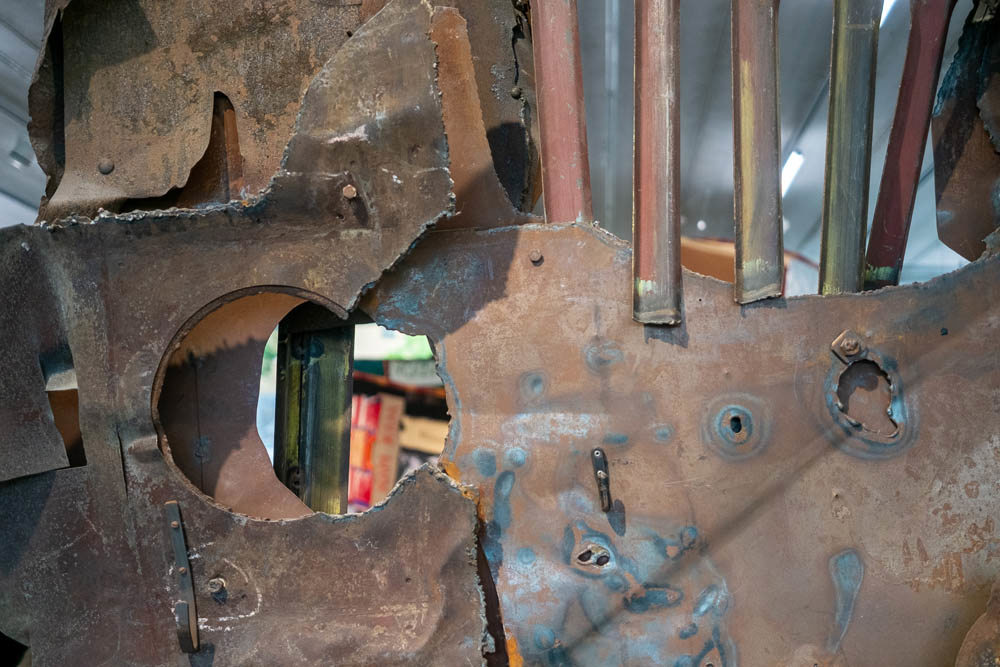
Details from Skråpuken.
The play was later performed on many other stages around the world, and various set designers interpreted this central fixture in different ways, often as a large human figure. But Gunilla Palmsteirna-Weiss’s version is something entirely different.
Constructed from rusty steel (she learnt to weld specifically for her work on the play), it is full of references and allusions to the economic and ideological core of colonialism. It features elements resembling prison bars, chains, parts of a military uniform, a bishop’s mitre and a nationalist flag. The materials used in the work are, also, the materials of colonialism: the oil barrels extracted from Angola’s soil and the corrugated iron used to build the slave labourers’ dwellings.
Skråpuken at SKH
Gunilla Palmsteirna-Weiss occasionally taught at what was then the Swedish Institute of Dramatic Art (DI), including a brief period as head teacher of scenography. And ever since the time when DI was based in Filmhuset, the sculpture has hung on the university's walls.
‘It was in the Filmhuset foyer, on the tall, wide concrete wall immediately to the right of what was then the entrance to the DI Theatre – now the SFI library entrance – and to the left of the wide marble staircase leading upwards to the east,’ explains Johan Andersson, a now-retired technician who worked at SKH for many years.
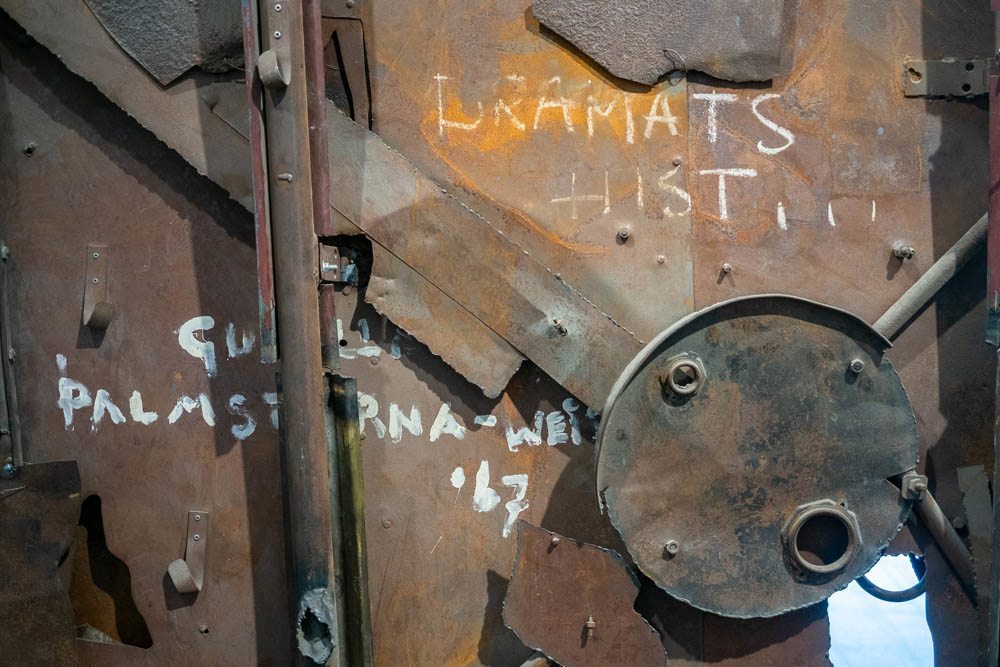
At Bonniers Konsthall, the work is positioned in the middle of the room, which means that visitors can also see the back of it – presumably for the first time in Skråpuken’s public history.
When DI moved to Valhallavägen 189, Skråpuken was also moved. It has hung in the studio corridor ever since – but this is actually not the first time it has been loaned out for an exhibition. In 2022, it was transported (’with considerable bother’, according to Johan Andersson) to Sven-Harrys Konstmuseum, the Tinguely Museum in Basel and Kunstverein in Hamburg for a travelling exhibition featuring several Swedish artists.
SKH is moving again soon, and it goes without saying that Skråpuken will be coming along this time too – as a source of inspiration and a reminder of the history of the university and of Swedish theatre.
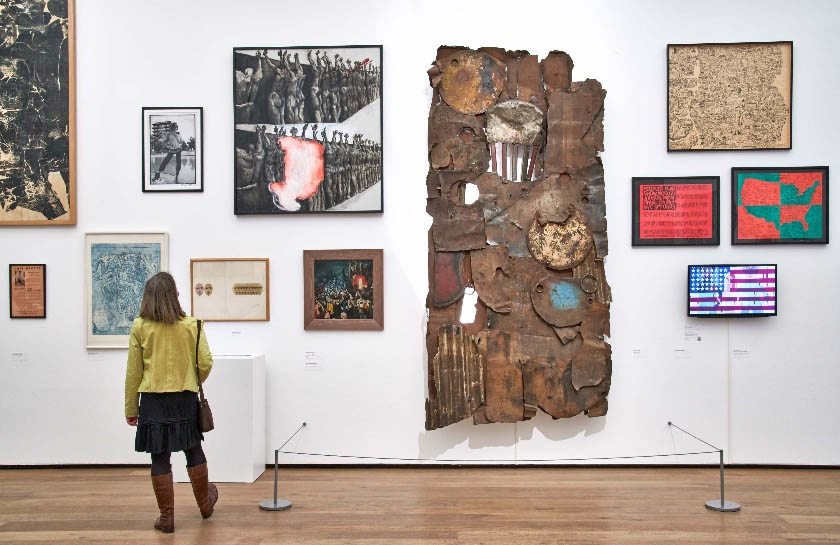
What Skråpuken looked like at Museum Tinguely’s exhibition Party for Öyvind. Öyvind Fahlström & Friends, 2022.
Fact box: Skråpuken at Bonniers Konsthall
Skråpuken is currently part of Bonniers Konsthall’s exhibition The Defeated: The Aesthetics of Resistance 2026, in which elements of Peter Weiss and Gunilla Palmsteirna-Weiss’s artistic oeuvre meet new interpretations of the themes addressed by their works, created for the exhibition by contemporary artists.
The exhibition closes on 8 November.
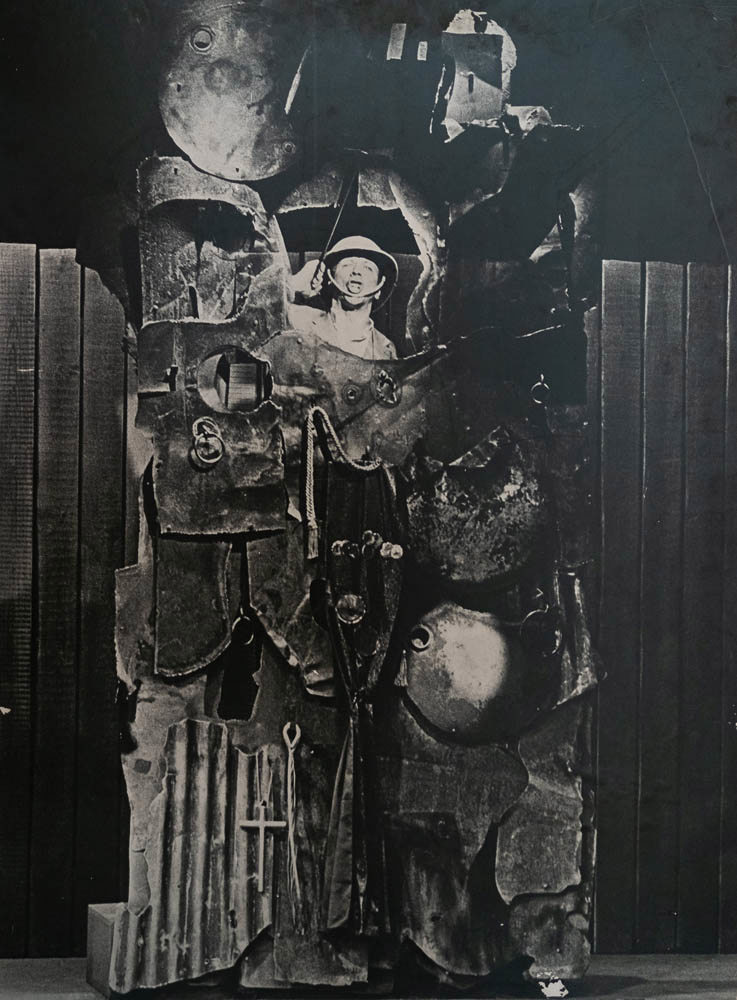
This is what Skråpuken looked like during the performance. In addition to what we can now see of the work, further colonial artefacts were hung there during the performance: pith helmets, crucifixes, order ribbons and a whip made of wire.
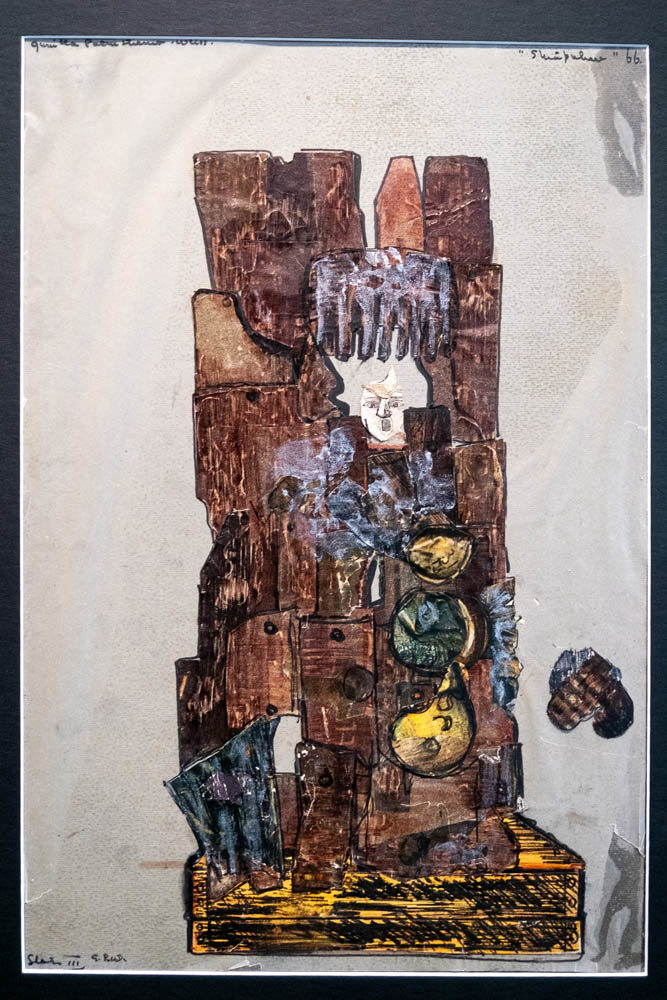
Gunilla Palmsteirna-Weiss’s preparatory sketch of what would become Skråpuken.
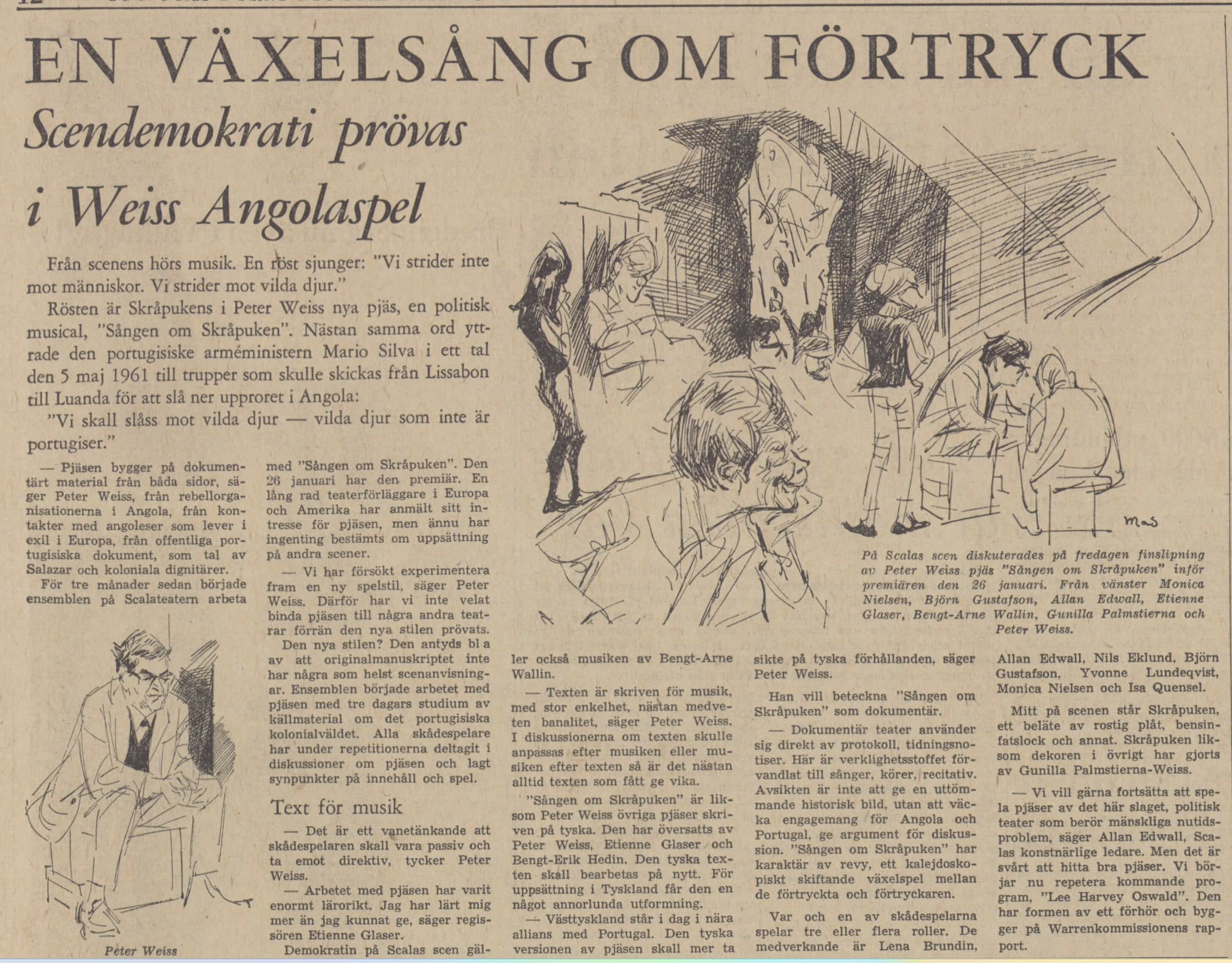
Article ahead of the premiere of Song of the Lusitanian Bogey, Dagens Nyheter, 14 January 1967. (in Swedish)
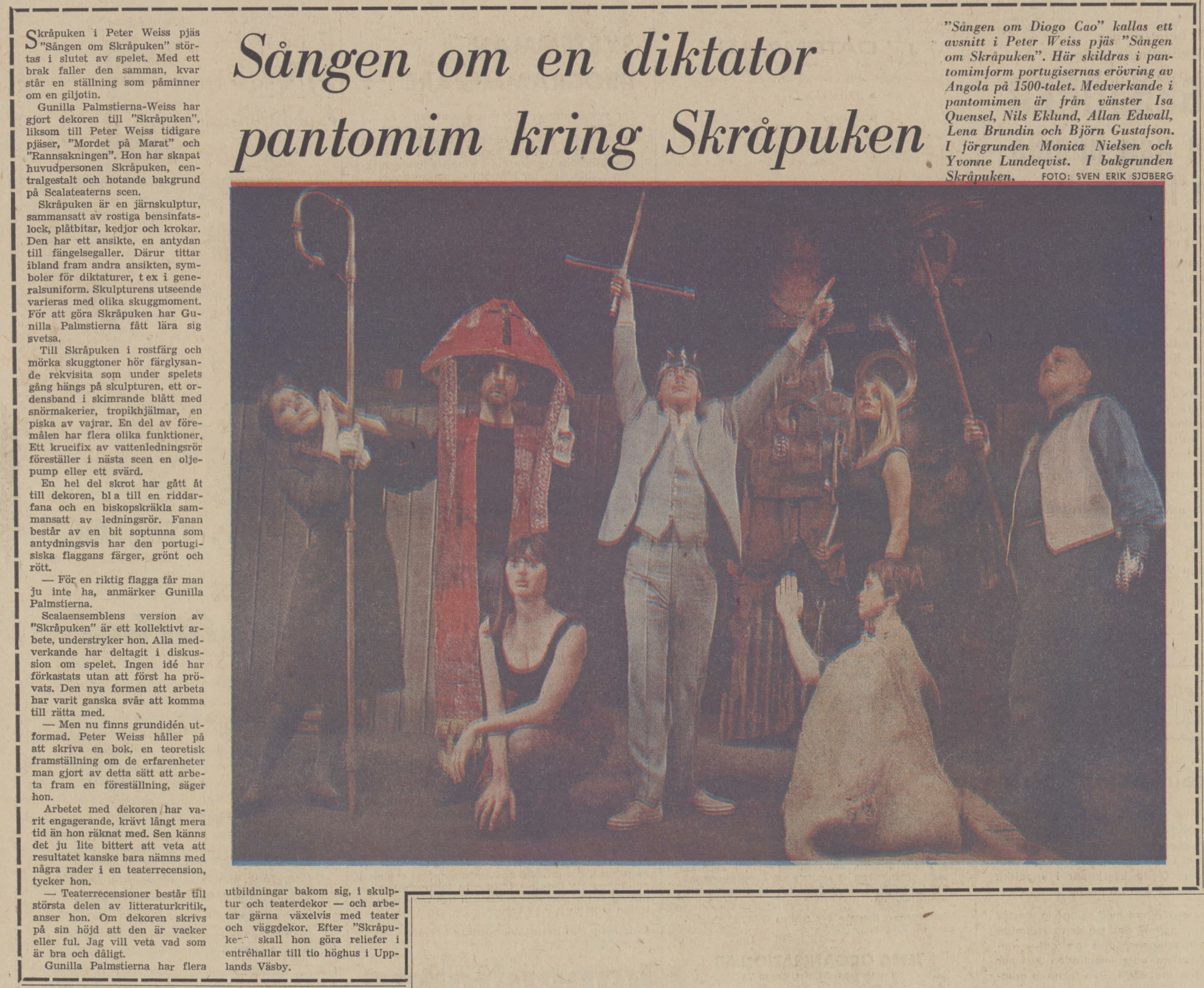
Article on Gunilla Palmstierna-Weiss’s work on Skråpuken, Dagens Nyheter, 26 January 1967. (in Swedish)
